
Why GuardPay Does Not Require KYC
You've probably noticed: almost every financial platform asks for your name, ID number, photo, proof of address. They say it's the law. They say it's for your protection. But what if there's another way—one that protects you without asking who you are?
That's GuardPay.
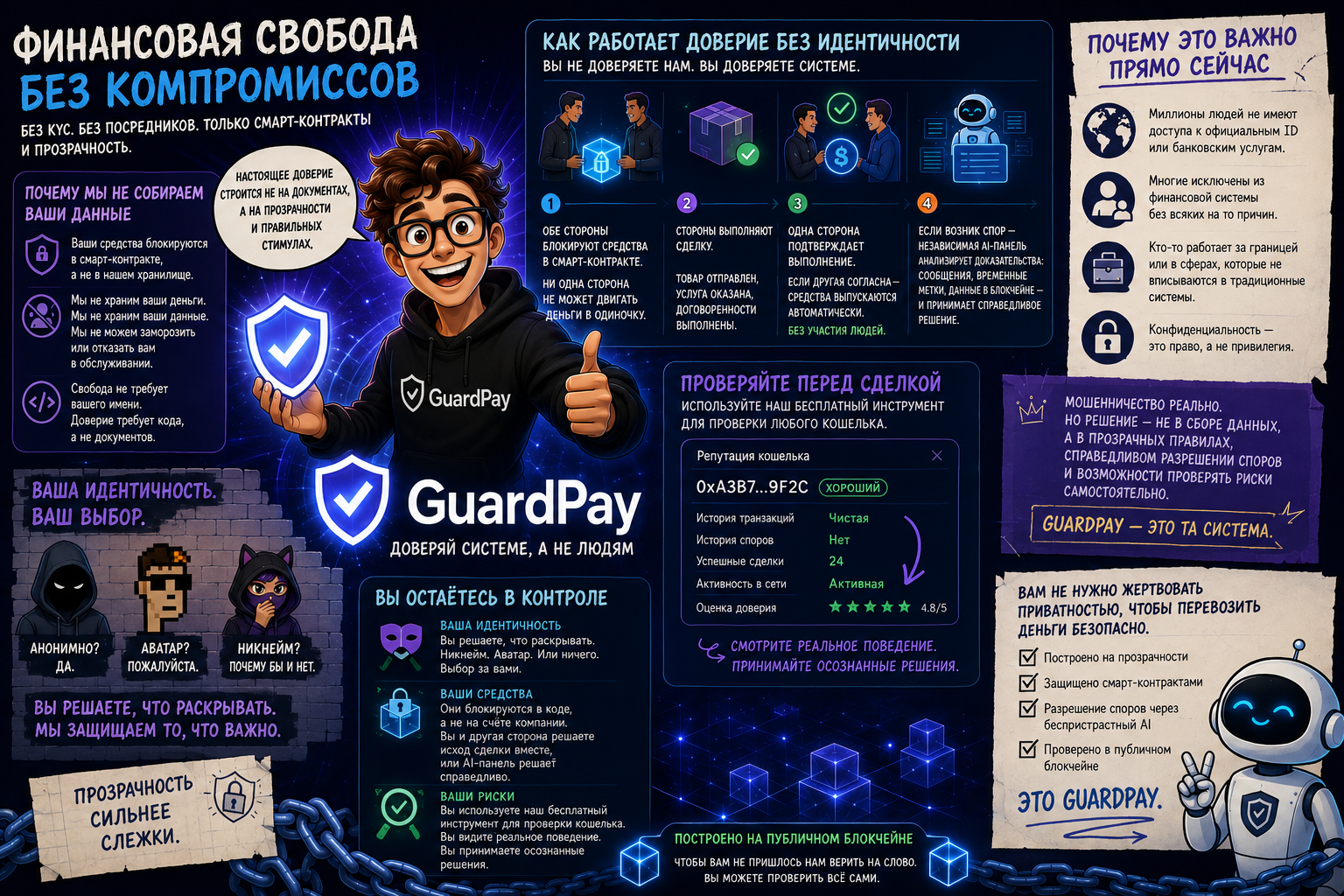
Why We Don't Collect Your Identity
GuardPay is built on a simple principle: your money should move without a middleman deciding who deserves access. Traditional escrow services—banks, payment processors, even some blockchain platforms—hold your funds. That means they control the keys. That means they need to know who you are, where you live, what you do. They collect this data to manage their own risk.
We designed GuardPay differently. Your funds lock in a smart contract on a public blockchain. Not in a company vault. Not on a server. In transparent code that runs the same way for everyone. We don't hold your money. We don't hold your data. We can't freeze your account or deny you service because of who you are.
That freedom doesn't require your name.
How Trust Works Without Identity
You might think: If you don't know who I am, how do you trust me? The answer is elegant. You don't trust us. You trust the system.
When two people meet on GuardPay, here's what happens:
- Both parties lock funds in a smart contract. Neither can move the money alone.
- They complete the trade—goods shipped, service delivered, whatever the agreement was.
- One party confirms completion. If the other agrees, funds release automatically. No humans involved.
- If they disagree, an impartial AI panel reviews the evidence—messages, timestamps, on-chain records—and decides fairly.
The system doesn't care if your name is real. It cares if your behavior is trustworthy. And you can verify that yourself: GuardPay offers a free tool to screen any wallet. You can see public on-chain data about an address—transaction history, dispute records, patterns. You decide who to trade with based on evidence, not on a name.
Real trust isn't built on documents. It's built on transparency and aligned incentives.
Why This Matters Right Now
Millions of people live in countries where getting an official ID is hard or expensive. Others have been excluded from banking for reasons that have nothing to do with financial risk. Some work across borders, in jobs that don't fit traditional employment categories. Many simply value privacy.
None of these people are criminals. None of them should be locked out of moving their own money.
At the same time, fraud is real. But the solution isn't to collect more personal data—data that can be stolen, leaked, or misused. The solution is to build systems where bad behavior has immediate consequences, where disputes are resolved fairly, and where you can evaluate risk yourself using public information.
GuardPay does this without knowing your name, because transparency is stronger than surveillance.
You Stay in Control
When you use GuardPay, you control three things:
- Your identity: You decide what you reveal. A username. An avatar. Or nothing. Your choice.
- Your funds: They lock in code, not in a company account. You and the other party decide the outcome together, or an AI panel decides fairly if you disagree.
- Your risk: You use our free screening tool to check the wallet you're trading with. You see real behavior. You make informed decisions.
This is what financial freedom looks like. Not the absence of rules. Not lawlessness. But a system built so that the rules protect you without controlling you.
You don't need to give up your privacy to move money safely. You need a system built on transparency, smart contracts, and impartial resolution. That's GuardPay. That's why we don't ask for your name. And that's why we built it on a public blockchain—so you never have to take our word for it. You can see for yourself.