
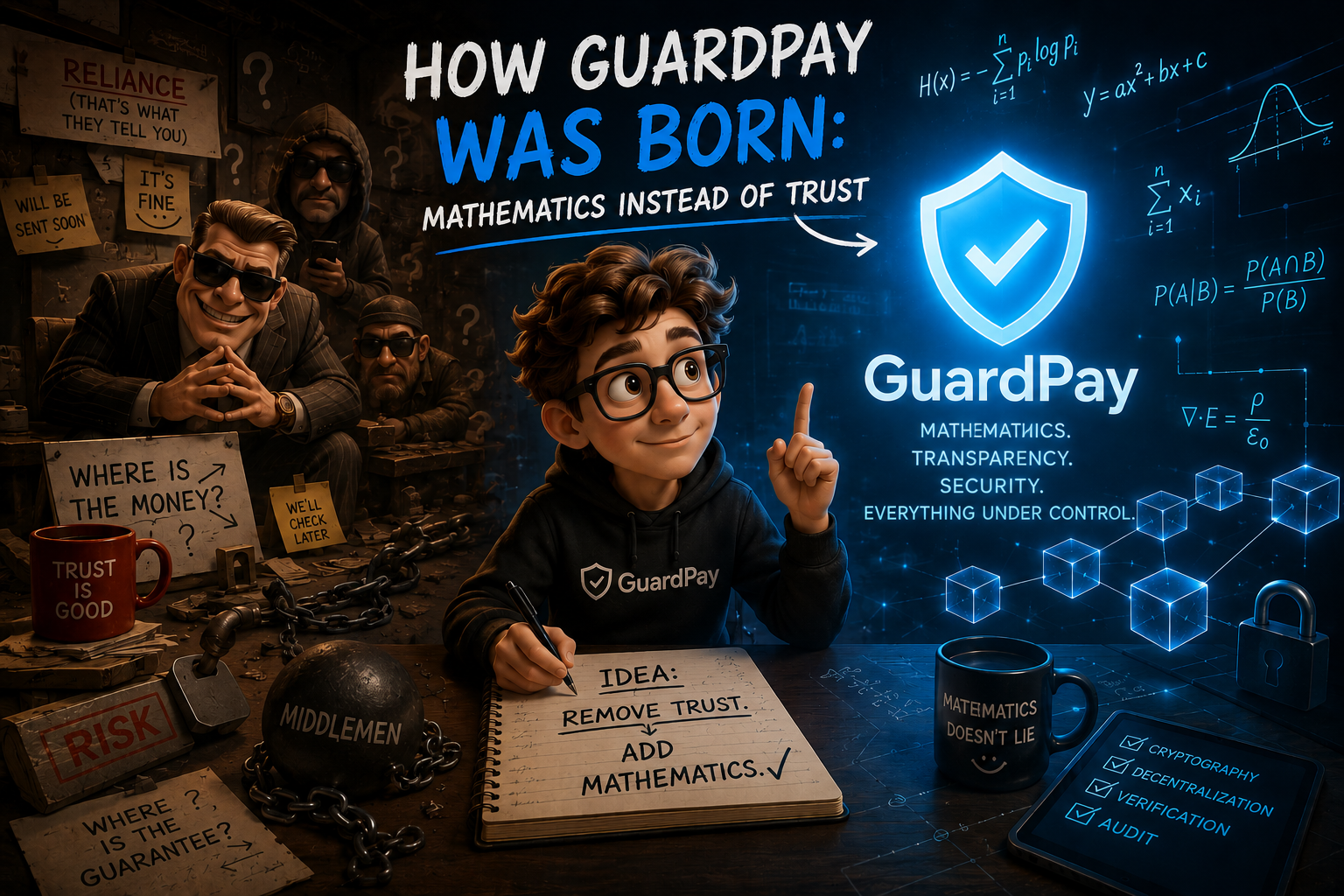
How GuardPay Was Born: Math Instead of Trust
Every day, two strangers somewhere in the world try to make a deal. One sells, one buys. One does the work, the other owes the payment. And every time, the same question appears — as old as commerce itself: who goes first?
Who sends the money first, risking that the goods never arrive. Who ships first, risking that the payment never comes. Between those two fears, millions of honest deals fall apart — and thousands of dishonest ones succeed.
Where it started
GuardPay was born from a simple observation: people lose money not because the world is full of scammers, but because honest people have no way to trust each other without a middleman they also have to trust.
A classic escrow agent is a person or a company that holds your money. Which means you have to believe in them. They can make mistakes, vanish, change their mind. So we asked a different question: what if we removed the human from the equation entirely? What if the role of guarantor were played by code — code that can't be bribed, can't be persuaded, and works identically for everyone, anywhere on Earth, around the clock?
We don't ask you to trust us. We built it so you don't have to trust anyone.
What we do
GuardPay is escrow on a public blockchain. When two people agree on a deal, the money is locked in a smart contract. Not with us. Not in a bank. In code that lives simultaneously on tens of thousands of independent computers and is controlled by no single party.
- Funds are protected from the first second. The seller sees the payment is already locked and guaranteed. The buyer knows it is released only when the terms are met.
- Only the participants decide. We cannot seize the funds, stop a deal, or interfere. It is not our money and not our power.
- Disputes are settled by AI. If the sides disagree, an impartial panel of AI arbiters hears both and rules in minutes — not in months of courts.
- No registration, no documents. It all begins with a single link.
Why we went beyond escrow
Protecting a deal is only half the job. The other half is helping people avoid the trap before it happens. So we built a free wallet-screening tool: anyone can paste an address and learn within seconds whether it is tied to sanctions, freezes, fraud schemes, or counterfeit tokens that disguise themselves as the real thing.
That whole picture is built purely from what is already written openly on the public blockchain — where every transaction is visible forever. We simply turn those open facts into something a human can read. Exactly how we do it is our craft and our work. But the result is free and available to everyone.
What we believe
We believe safety shouldn't be a privilege. That a person in any country — with no bank, no lawyer, no connections — deserves a fair deal. That transparency beats promises, and that math is more honest than any middleman.
GuardPay is for the freelancer who didn't get paid. For the buyer afraid to send first. For two partners who want to start something but don't yet trust each other. For everyone tired of choosing between "take the risk" and "walk away."
We're only at the beginning. But the direction is set for good: to make trust between strangers no longer a matter of luck, but a matter of math.